" width="25.92px"><path d="M 1.015 3.385 L 1.002 3.388 L 0.917 3.433 L 0.893 3.438 L 0.876 3.433 L 0.791 3.388 C 0.778 3.384 0.768 3.386 0.762 3.394 L 0.757 3.407 L 0.737 3.957 L 0.743 3.983 L 0.755 4 L 0.88 4.095 L 0.898 4.1 L 0.912 4.095 L 1.037 4 L 1.051 3.979 L 1.056 3.957 L 1.036 3.408 C 1.032 3.395 1.026 3.387 1.015 3.385 M 0.253 0 L 0.238 0.003 L 0.016 0.122 L 0.004 0.135 L 0 0.149 L 0.022 0.702 L 0.028 0.717 L 0.037 0.726 L 0.278 0.846 C 0.294 0.85 0.305 0.847 0.313 0.836 L 0.318 0.818 L 0.277 0.028 C 0.273 0.013 0.265 0.003 0.253 0 M 0.475 3.243 C 0.464 3.235 0.45 3.239 0.443 3.25 L 0.436 3.268 L 0.395 4.058 C 0.396 4.073 0.402 4.083 0.415 4.089 L 0.433 4.086 L 0.674 3.966 L 0.686 3.956 L 0.691 3.942 L 0.712 3.389 L 0.708 3.374 L 0.696 3.361 Z" fill="transparent" height="4.100142877987455px" id="RQ3946eaU" transform="translate(0 22.661)" width="1.0560000745773277px"/><path d="M 21.6 0 C 23.986 0 25.92 2.015 25.92 4.5 L 25.92 22.5 C 25.92 24.985 23.986 27 21.6 27 L 4.32 27 C 1.934 27 0 24.985 0 22.5 L 0 4.5 C 0 2.015 1.934 0 4.32 0 Z M 21.6 3 L 4.32 3 C 3.525 3 2.88 3.672 2.88 4.5 L 2.88 22.5 C 2.88 23.328 3.525 24 4.32 24 L 21.6 24 C 22.395 24 23.04 23.328 23.04 22.5 L 23.04 4.5 C 23.04 3.672 22.395 3 21.6 3 M 7.2 10.5 C 7.93 10.5 8.545 11.069 8.63 11.825 L 8.64 12 L 8.64 19.5 C 8.639 20.294 8.045 20.949 7.284 20.996 C 6.524 21.042 5.86 20.464 5.77 19.676 L 5.76 19.5 L 5.76 12 C 5.76 11.172 6.405 10.5 7.2 10.5 M 11.52 9 C 12.216 9 12.812 9.518 12.937 10.231 C 13.227 10.057 13.527 9.9 13.834 9.762 C 14.795 9.334 16.233 9.099 17.532 9.523 C 18.213 9.748 18.897 10.168 19.404 10.884 C 19.858 11.521 20.102 12.297 20.151 13.168 L 20.16 13.5 L 20.16 19.5 C 20.159 20.294 19.565 20.949 18.804 20.996 C 18.044 21.042 17.38 20.464 17.29 19.675 L 17.28 19.5 L 17.28 13.5 C 17.28 13.005 17.165 12.774 17.09 12.667 C 16.982 12.528 16.834 12.429 16.668 12.385 C 16.167 12.22 15.445 12.307 14.966 12.52 C 14.246 12.841 13.586 13.345 13.137 13.812 L 12.96 14.01 L 12.96 19.5 C 12.959 20.294 12.365 20.949 11.604 20.996 C 10.844 21.042 10.18 20.464 10.09 19.675 L 10.08 19.5 L 10.08 10.5 C 10.08 9.672 10.725 9 11.52 9 M 7.2 6 C 7.995 6 8.64 6.672 8.64 7.5 C 8.64 8.328 7.995 9 7.2 9 C 6.405 9 5.76 8.328 5.76 7.5 C 5.76 6.672 6.405 6 7.2 6" fill="rgb(0, 0, 0)" height="27px" id="dtrxfAoz8" width="25.92px"/></g></svg>)




SnapOut! - Breaking the Scroll
Rethinking digital well-being through subtle interventions
Year
Fall 2024
Category
UX Research, Full-Stack App Development
Tools
Apple Shortcuts, Figma, Python
SUMMARY
Social media is designed to be hard to leave. Even the most disciplined users find themselves stuck in endless scrolling loops, losing time, focus, and sleep.
SnapOut! is a lightweight automation tool designed to gently interrupt mindless scrolling habits in real time.
Rather than enforcing hard limits, it introduces subtle moments of friction that encourage awareness and reflection.
In a 48-hour field study, participants who used SnapOut! reduced their average screen time by 40%, helping them disengage faster without feeling forced.

THE PROBLEM
Why Screen Time Isn’t Cutting It
Most digital well-being tools are built around one idea: Set a limit, lock the app, and the problem goes away.
But that’s not how people actually behave.
Research Participant A
“I used to set a limit for Instagram but I find myself turning it off everyday.”
Research Participant B
Features like Screen Time on iPhones or daily time limits on social media apps try to block access after a threshold is met, but users ignore the warning, extend the time, or disable the feature entirely. What starts out as a helpful reminder eventually just feels nagging, punitive, and easy to bypass.
Social media platforms are engineered around dopamine-driven feedback loops. Features like infinite scroll, variable rewards, and algorithmic personalization are designed to maximize time on the app.
These systems don’t just capture attention, they train habits, releasing dopamine and reinforcing the behavior until it becomes a "cue-behavior-reward" loop.
So when users try to limit themselves, they’re fighting against systems designed to keep them engaged.
Insight: Users already know they’re spending too much time scrolling, they just lack the right moments of interruption to act on it.
DISCOVERY & RESEARCH
What's Actually Stopping People
Most people don’t lack awareness, they lack the right moment to act on it.
I conducted a study of young adults, a few patterns kept showing up:
Too involved
Setting up tools like Screen Time or habit-tracking apps take intentional effort, and most people don’t stick with it.
Motivation isn’t consistent
Users don't always want to reduce screen time. Sometimes people just want to relax for a bit. Existing tools treat every session the same, which makes them feel rigid.
High barrier to entry
Some participants didn’t want to fully block apps, commit to strict limits, or pay for another subscription just to manage their screen time.
What users wanted was something lighter. Something that worked with their habits instead of against them.
Insight: People don’t want to quit social media. They just want help stepping away before one quick scroll turns into an hour.
PROCESS
Meeting Users Where They Scroll

I initially envisioned my project as a Chrome extension that would intervene directly within social media feeds. However, interviews revealed that most participants weren't spending hours doomscrolling on their laptops, they were doing it on their phones. That realization forced a major pivot.
When I began designing for mobile, I ran into another challenge: on iOS, apps can't overlay timers, blockers, or notifications on top of other apps like Instagram or TikTok. The intervention couldn't live inside the scrolling experience the way I had originally imagined.
Instead of fighting against the platform's limitations, I looked for a different approach. This led me to iOS Shortcuts, which allowed SnapOut! to surface awareness and interruptions at key moments while still respecting how people naturally used their devices.
What started as a technical constraint ultimately shaped the core philosophy of the project: rather than forcing people to stop scrolling, help them recognize when they want to stop.
THE SOLUTION
Introducing SnapOut!
SnapOut! is a lightweight, adaptive intervention system that activates when users open social media apps.
Instead of locking users out: it surfaces real-time usage awareness, introduces small interruptions, and adapts to behavior in real time.
Designed Around Adaptive Friction
As users hit usage thresholds, SnapOut intentionally nudges them in a subtle, but progressively more noticeable way.
Pause Before You Scroll
“You’ve opened Instagram 10 times today”
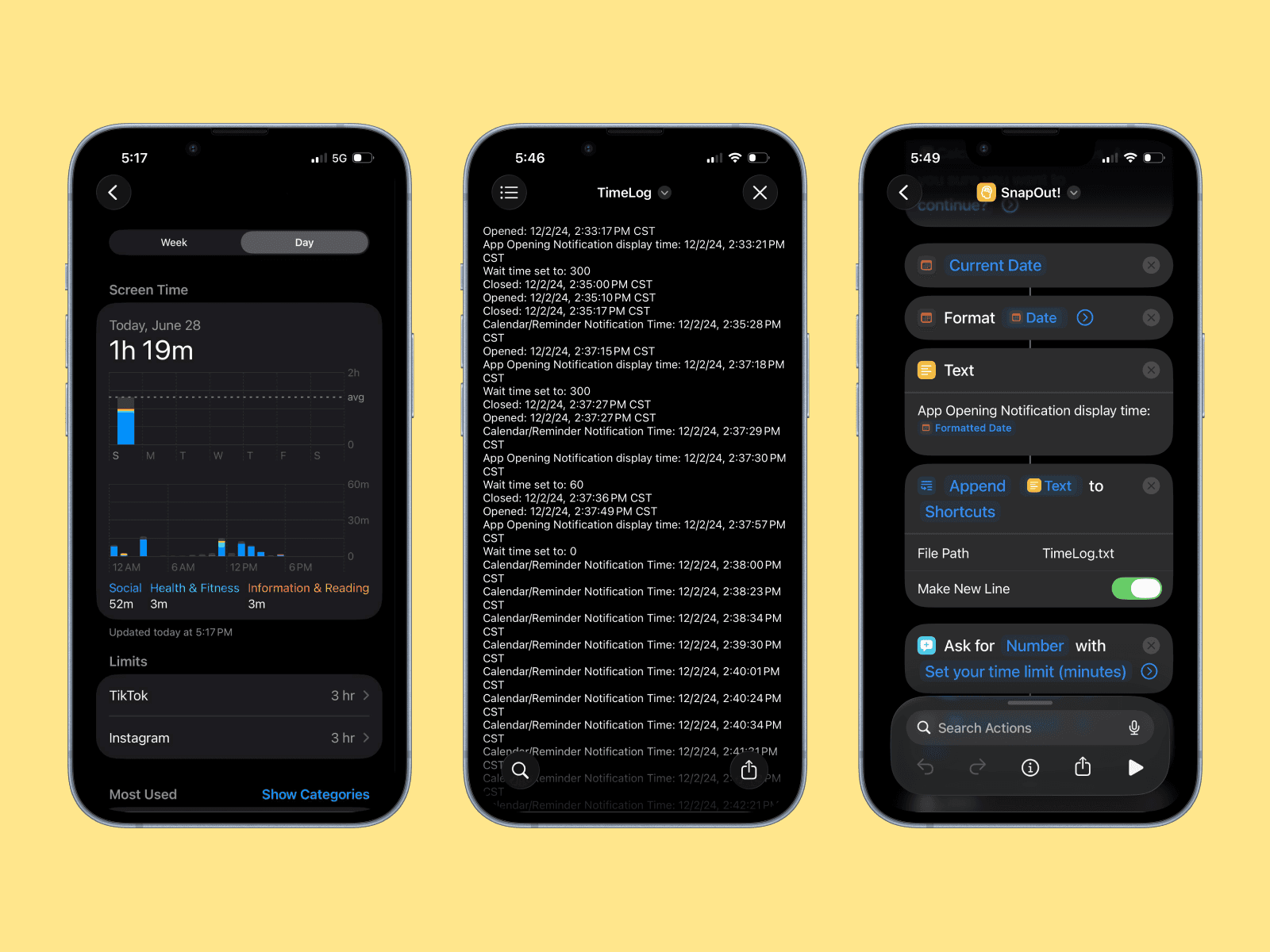
Every new scrolling session begins with a small moment of awareness. Before opening the app, SnapOut! surfaces how many times you've already visited that platform today and lets you intentionally choose a session length before continuing.
Time-Based Reminders
“You started scrolling 5 minutes ago.”
Once the session timer expires, SnapOut! gently reminds users how long they've been scrolling. The goal is to make the passage of time visible before a quick check-in turns into an hour.

Contextual Prompts
“Project Team Meeting in 10 minutes”
SnapOut! displays reminders from your calendar and to-do list to reconnect you with what matters offline. These personalized nudges encourage reflection by reminding users of the things they're scrolling past.
Visual Friction
Grayscale Filter
After prolonged scrolling, SnapOut! gradually switches the screen to grayscale, reducing the visual stimulation that keeps users engaged and quietly making scrolling less rewarding.
RESEARCH STUDY
Putting SnapOut! to the Test
Designing SnapOut! was only half the challenge. I also wanted to know whether subtle interventions could actually change behavior outside of a controlled environment.
I conducted a 48-hour longitudinal field study with nine iPhone users (ages 18–25). The study combined pre- and post-study interviews, iOS Screen Time metrics, and passive usage logs collected by SnapOut! to measure both behavioral change and participant experience.
Participants first shared their existing screen time habits and previous attempts to reduce social media use before installing SnapOut! on their own devices. They then used their phones as they normally would for 48 hours while the system delivered adaptive interventions and recorded anonymous usage data through logs. After the study, I collected participants' usage logs and participants completed a follow-up interview and submitted their updated Screen Time metrics, allowing me to compare quantitative changes alongside qualitative feedback.
Outcome: This mixed-methods approach gave me both the measurable outcomes and the participant perspectives needed to understand how subtle interventions influenced real-world behavior.
LEVERAGING AI
Behind the Scenes: Using AI to Accelerate Research
With interview transcripts, survey responses, and usage logs with timestamp metrics coming in from multiple participants, I needed a way to quickly identify patterns without spending hours manually sorting data.
To streamline the process, I used a combination of Python and AI-assisted analysis to clean, organize, and synthesize research findings. Python scripts helped process screen time data and generate visualizations, while AI accelerated thematic analysis by helping cluster participant responses and surface recurring trends.
Rather than replacing the research process, these tools allowed me to spend less time on manual data processing and more time interpreting insights, validating findings, and refining the experience.
Result: Faster analysis, quicker iteration cycles, and more time focused on design decisions.
THE RESULTS
Did It Work?
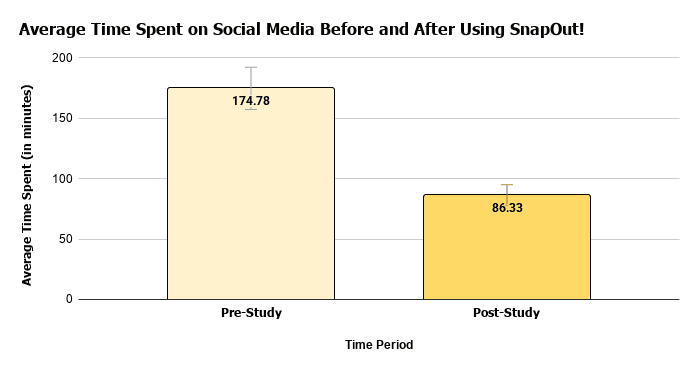
Participants’ average time spent on social media dropped from 174.8 minutes to 86.3 minutes per day, which is a 40% reduction in overall screen time. A paired t-test confirmed this change was statistically significant (t = 2.32, p = 0.049 ).
What Made the Difference
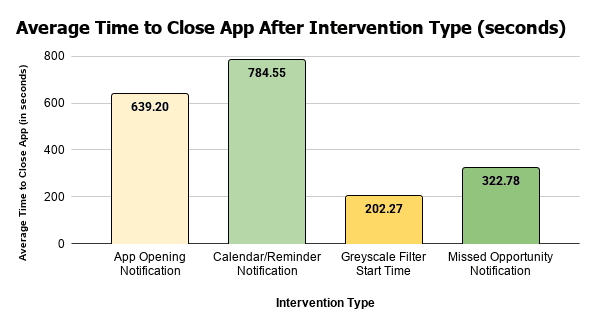
Not every intervention worked equally. Some nudges blended into the background over time, while others created stronger moments of interruption.
The most effective intervention ended up being surprisingly simple: grayscale mode, with an average reaction time of 3.4 minutes. Participants consistently disengaged faster once the app became visually less stimulating.
Participant A
“Seeing how many times I’ve opened Instagram made me realize I should stop.”
Participant B
Contextual reminders also stood out because they reconnected users to things happening outside their phones, like meetings, assignments, real-life priorities.
Meanwhile, usage notifications increased awareness, but were easier to dismiss once users became familiar with them.
Together, these findings helped prioritize which interventions to refine and which to rethink in future iterations of SnapOut!.
REFLECTIONS
It Was Never About Willpower
I started this project believing digital well-being tools failed because people lacked discipline. What began as a personal attempt to curb late-night doomscrolling turned into something else entirely: a realization that the real issue isn’t motivation, it’s awareness.
People don’t want more restrictions or blockers. They want help recognizing the moment when intentional use quietly slips into autopilot.
Reframing the solution around that moment proved powerful. With small, well-timed interruptions, participants not only reduced their overall screen time by 40%, but were able to disengage more quickly once they started scrolling.
I didn’t set out to eliminate social media. I just wanted to get my time back, and help others do the same. In the end, SnapOut! became something simple: not a restriction, but a reminder arriving at the exact moment we forget we’re still choosing.